

Wind and hail that cut across the southern Alberta prairie last month left a "scar" visible from outer space.
On Aug. 20, 2025, 150-kilometre-per-hour gusts shredded crops and stripped grass and ground cover. The storm slashed from south of Calgary to Saskatchewan, affecting about 425,000 acres of insurable crops, plus pasture and native grassland.
Severe thunderstorm in southern Alberta downs power lines, damages cars
Trail of destruction in Brooks, Alta., after golf ball-sized hailstorm rips through
That most intense zone of the storm — a sort of epicentre that dragged for hundreds of kilometres — left behind a "hail scar" that can be seen in satellite images published by U.S. space agency NASA.
A satellite image of southern Alberta shows a line of damage and soil displacement caused by high wind and hail.
A patchwork of green shades, representing crops, hay and clumps of trees is replaced by a smear measuring about 15 kilometres wide and 200 kilometres long.
It starts near Vulcan, south of Calgary, and shows the worst damage centred north of Brooks where acreage owners and agricultural producers had home siding demolished down to the nail points. Corn stalks tore in half. Irrigation pivots overturned. Asphalt shingles were sanded bare.
Researchers from the Northern Hail Project at Western University studied the storm's effects on the ground afterwards. It concluded the heaviest damage, "among the worst the NHP has documented to date," occurred over 22 kilometres north of Brooks.
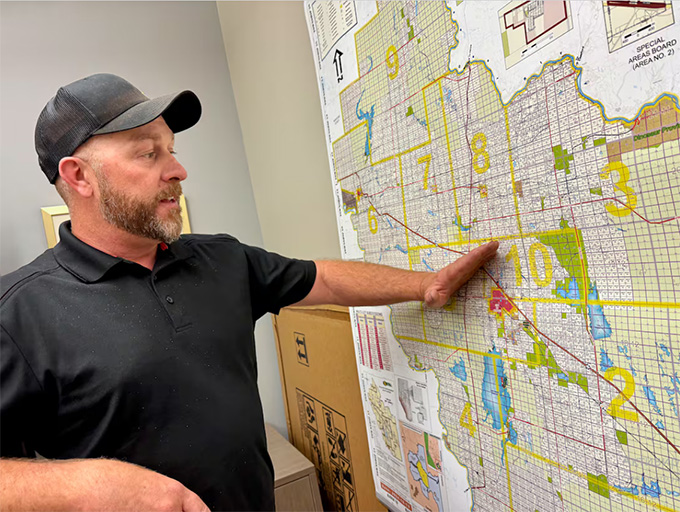
A man points at a map of the Alberta county of Newell, near Brooks, to illustrate the path of hail storm.
Such storms are not uncommon in southern Alberta.
Freelance storm chaser Kyle Britain has listed 12 examples of "hail scars" on his website that have appeared in the province since 2000.
While they await insurance adjusters, farmers who can work sections a dozen or more kilometres apart still have to harvest crops that avoided the worst damage. What little is left on badly damaged fields will be cut up for livestock feed or plowed under.
Source of information & photo: CBC